


Health is often viewed as a social issue, but it is just as much an economic one. In developing countries, a strong health system stabilizes communities, supports productivity, and strengthens long-term growth. Guyana is no exception. In recent years, we have undergone a rapid economic transformation driven by oil revenues, and investment in health has been one of the Government’s prime focuses.
I see it not only as a moral obligation but also as an economic strategy, because a healthy population is inherently more productive. When workers are physically well, they perform better and contribute more, and at the household level, the benefits of good health are immediately evident.
Health and Economic Growth
Investments in healthcare contribute directly to the Gross Domestic Product (GDP) because health services generate jobs. The Government of Guyana and its Ministry of Health have made significant investments in training programs to boost the health sector. To date, thousands of persons, including youth, have been trained in patient care, midwifery, nursing, laboratory technology, and other fields, and are now employed within the sector across both coastland and hinterland regions.
This link between health and human development is at the center of national progress.
Expanding Infrastructure and Access
Guyana’s health system has expanded significantly over the past five (5) years, transforming the health landscape. The Ministry of Health has established six (6) new regional hospitals across the coastlands, with six (6) more currently being constructed in the hinterland. In addition, more health posts and health centers have been commissioned as part of efforts to strengthen human capital.

Most importantly, these investments support equity. For many years, access to high-quality healthcare was limited in hinterland areas, contributing to poorer illness outcomes and lower life expectancy. The Government is reducing this disparity by building new hospitals and distributing skilled workers across all regions, guaranteeing more inclusive economic growth.
Every person, regardless of location, should have access to a healthcare system that promotes national unity and advances Guyana’s efforts to meet Sustainable Development Goals, particularly those related to health, poverty alleviation, and inequality reduction.
Prevention as a Cost-Effective Strategy
In addition to enhancing infrastructure, the Ministry of Health has increased its emphasis on prevention, recognizing that it is both more effective and more cost-efficient to prevent illness than to treat advanced conditions. In recent years, Guyana has expanded its national vaccination programs, protecting both children and adults from communicable diseases such as measles, HPV, and COVID-19. The Ministry has also strengthened vector control initiatives, including extensive fogging, distribution of insecticide-treated nets, and community education campaigns to reduce mosquito-borne diseases like malaria and dengue—conditions that primarily affect hinterland populations.
Screening and Early Detection
Through the Ministry’s voucher program, thousands of individuals have been screened for chronic conditions such as diabetes, hypertension, and cervical cancer by public health units nationwide. Early detection reduces long-term medical costs and prevents complications that can limit a person’s ability to work or care for their family.
Maternal and child health programs have also been prioritized to improve outcomes for women and babies, with expanded prenatal care, nutrition support, and breastfeeding education. Additionally, mental health has become an increasing focus, with community-based services and awareness initiatives aimed at reducing stigma and encouraging early intervention.
Reducing Financial Barriers to Care
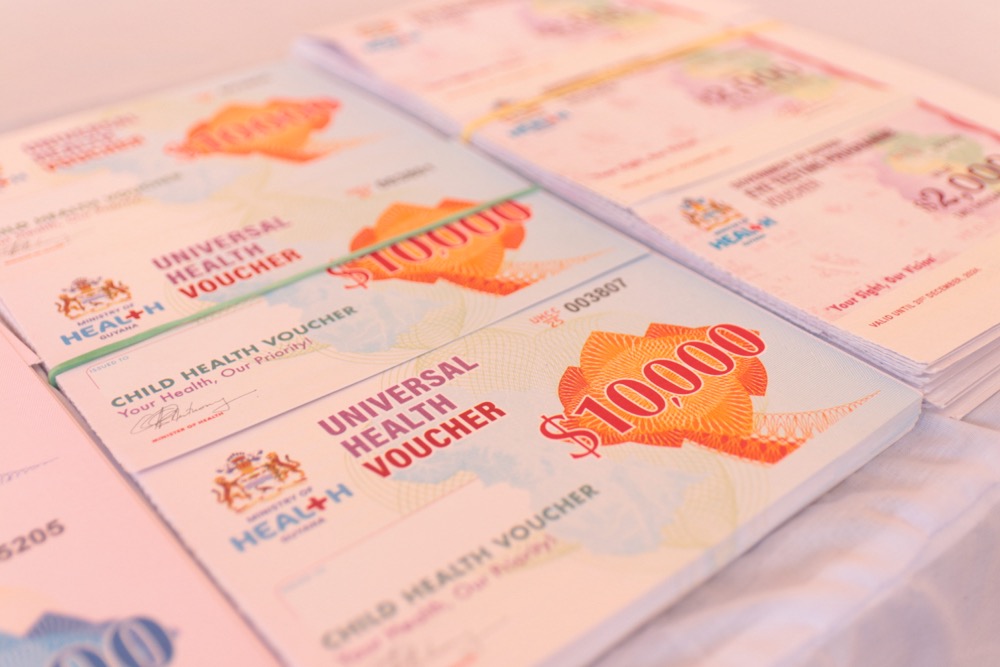
Beyond preventive programs, the Ministry of Health has introduced several healthcare voucher initiatives designed to reduce financial burdens and improve access to essential services, particularly for low-income families.
These vouchers allow citizens to access key services at no cost, including cervical cancer screening, maternal healthcare, eye examinations, dental services, and general wellness checks.
By removing financial barriers, the Government ensures greater participation in early detection and routine care—both critical components of a strong preventive health system.
These initiatives are especially impactful in remote and rural communities, where out-of-pocket costs previously discouraged timely medical care.
Expanding Access to Life-Saving Treatment
Another major step toward equitable healthcare is the Government’s increased support for dialysis treatment, a life-saving service for individuals with chronic renal disease. Dialysis is often prohibitively expensive and requires multiple treatments each week, placing significant strain on households.
To address this, the Ministry provides substantial financial assistance through a nationwide dialysis subsidy program that helps cover treatment costs at approved facilities. In addition to reducing mortality, this program allows patients to continue working, supporting their families, and participating more fully in community life.
New dialysis centers have also been established across various regions, reducing travel time and improving continuity of care for patients who previously had to travel frequently to Georgetown.
Conclusion: Investing in the Nation’s Future
In essence, the transformation of Guyana’s health system is not only an investment in infrastructure, programs, and personnel—it is an investment in the nation’s future. A healthier population increases productivity, expands economic participation, and ensures that growth remains inclusive and sustainable.
By strengthening infrastructure, prioritizing prevention, implementing voucher programs, and reducing the financial burden of life-saving treatments like dialysis, the Government is building a system that places people at the center of development.
As Guyana continues its rapid economic expansion, these strategic investments in health will serve as the foundation for a more resilient, empowered, and prosperous society. Ultimately, the nation’s greatest resource is its people, and a strong health system ensures that every citizen is equipped to thrive and contribute to Guyana’s continued progress.